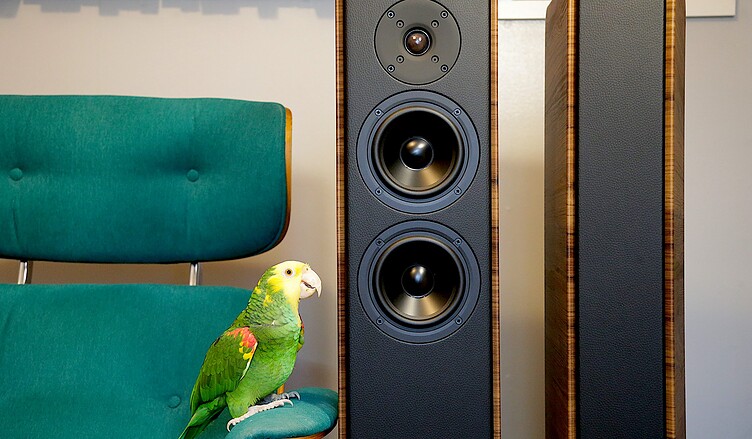
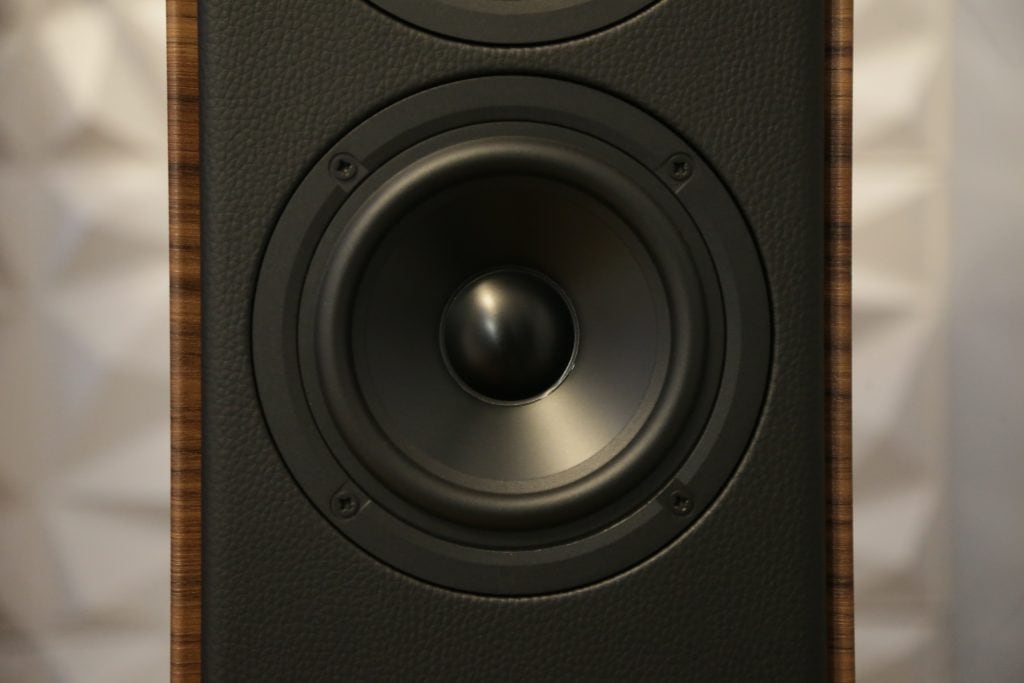
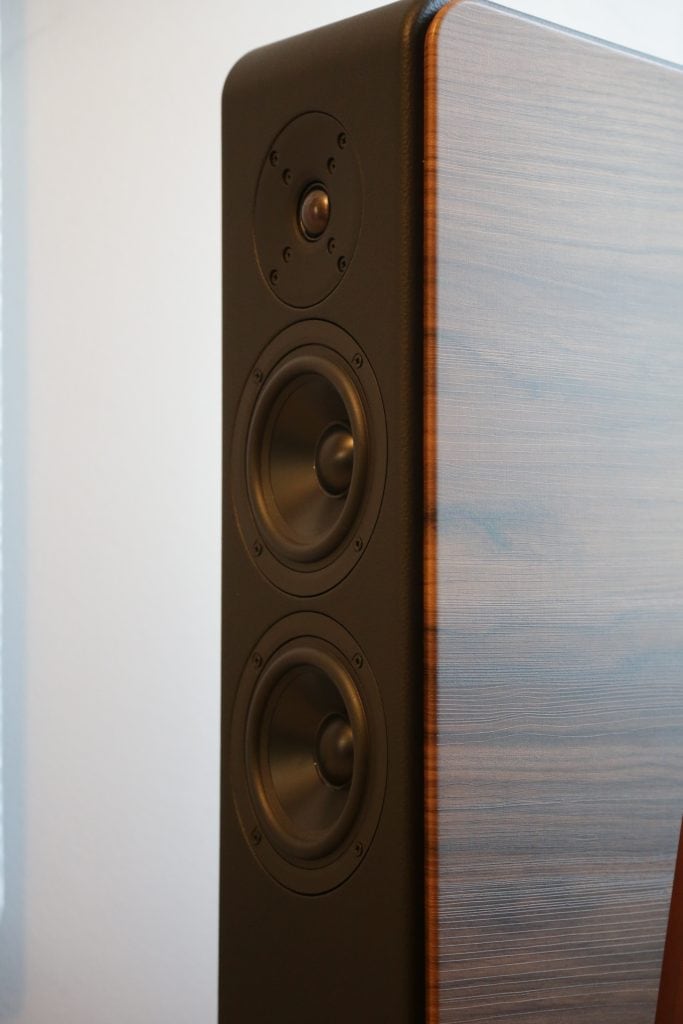
Fidelity Imports reached out to me to see if I would like to check out the Grand Mezza V2 speakers from Opera Loudspeakers. I was pretty excited for the opportunity to try out a pair of Opera speakers in my system. The Grand Mezza V2s are their smaller floorstander in the Classica Line, and while they may appear small, they weigh much more than they look like they would. They also sound much larger than they look, though we will get into that more later. The pair I have in for review is finished in rosewood and leather. They also offer these in a cement gray finish on the side panels. I have not seen the cement grey in person; however, the rosewood looks gorgeous, and the leather along the front, top, and back complements it nicely. The Grand Mezza V2 is a 2.5 way rear ported bass reflex design, so while you do not have dedicated bass woofers, you still get plenty of low end. The two mid-woofers are 5″, and made in collaboration with Scan Speak, a highly regarded speaker manufacturer. The tweeter is a 26mm soft dome unit, which, to be honest, is usually my favourite style. The Grand Mezza V2 retails for $5,999.00 U.S., while not cheap, they still fall within reach for many audiophiles. So how do they perform? Let’s dive in and find out.
Unboxing and Setup
The Grand Mezza V2s come in some rather large boxes, with plenty of space around them to keep any dings from shipping well away from your new speakers. Once you open them up you will be greeted with the speaker and accessories in fitted foam, which easily slide out with the box upright. I made sure to slide them out upside down so I could install the admittedly substantial feet and spikes while the top was secure in its foam cradle. Once the feet and spikes were on both, I flipped them over and got them in my music room. I played with positioning for about a week, starting them right where my Sonus Fabers Sit. I tried some different toe angles as well as distances to the side and rear walls. Ultimately, I settled on a spot a little further out from the rear than my Sonettos go and a bit less toe-in. Obviously, every room will be different, but being rear-ported, I prefer them to have a little more breathing room behind them than my bottom-ported Sonettos. Wiring them into your system is as easy as can be; they have a single set of very nice binding posts so positive to positive and negative to negative, and you’re ready to listen.
Sound
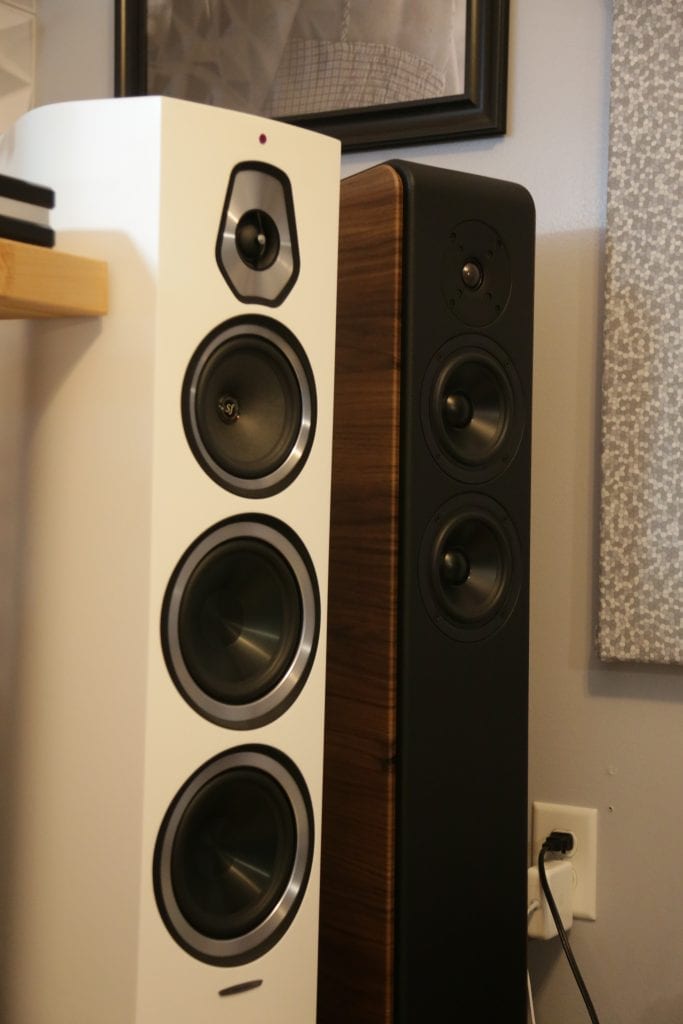
One of the reasons I was excited to check out the Grand Mezzas is that they, like my Sonetto Vs, are Italian and they share some similar design language as well as being fairly close in price and size. I thought it would make for a very interesting comparison. While the Sonettos, like the Grand Mezzas, are on their second generation, the first gen is fairly comparable in tone and sound to the latest gen Sonetto, so I think the comparison should hold up pretty well. The biggest difference is that the Sonettos are a 3 way with two 8-inch woofers, so will the unique bass reflex implementation of the Grand Mezzas help them reach the same low end, which, among many other things, I intended to find out.
Before I get into the comparison, I want to talk about how the Grand Mezzas sound on their own. I powered them with two differnet amplifiers, first my new Advance Paris X-A160, as well as the Cambridge AXR100 integrated amplifier. The X-A160 has 160 watts into 8Ω and 240 watts into 4Ω; the Cambridge does 100 watts into 8Ω and around 150 watts into 4Ω. The Grand Mezza V2s have a nominal impedance of 6Ω and a minimum of 3.8Ω, so they can take advantage of extra power on tap when playing more demanding tracks. They also have a sensitivity of 92 dB, so they shouldn’t need a ton of power to sound good in most spaces.
A track I love to play with new speakers and in general is “Lost In Cosmos by Kozah. This is an electronic instrumental track that would be right at home in a movie like Interstellar. It has a deep, punchy bass foundation with layered synths and strings to create this dramatic scene. The song also has an absolutely thrilling drop. It covers the entire frequency range and has great dynamics and speed that can really push a speaker. Something I want to emphasize is the bass in the track; it’s deep and powerful, and when I was first hooking up the Grand Mezzasm and I played it, I didn’t realise I had forgotten to plug my subwoofer back in. It wasn’t until later, when I tried adjusting the subwoofer level on my Marantz, that I noticed nothing changed; well, my Defiance V8 sub was not even plugged in. So to answer one of our questions, yes, the Grand Mezza V2 can reach low and has great bass output. They also do not get muddy at all.
One thing Opera really hits on with their speakers is vocal presentation. I have a few go-tos for vocals. Laufey, Taylor Swift, and Ethel Cain are among my favorites, as well as being very, very familiar with their music. I have heard all three live and have played all three on hundreds of systems now. For those listening sessions, I wanted to use vinyl. I played all three artists on the VPI Forever Model 1 with the 12″ Fatboy gimbal arm and Shyla Cart. The Phono pre is the VPI Avenger Preamp. My analog front end is much more serious than digital, as it is what I enjoy the most, so it felt like the appropriate way to listen to some great vocals. One of my favorite tracks from Cain’s “Willoughby Tucker I Will Always Love You” is “Dust Bowl”. It’s a gritty, raw track, and it’s mastered to really drive that feeling home. After the second line in the second chorus, the guitar comes in strong, and it’s one of those moments where you get chills. That said, back to the vocals, and throughout the whole album they are incredibly lifelike. The whole of the midrange is great. The two mid drivers, one being for lower mids, create a lush, smooth midrange that supports natural-sounding vocals very well. The midrange also has loads of detail and clarity.
Next up was Laufey, Bewitched, which is such a great album. Laufey does a really good job of blending modern sounds with classical and jazz. Her voice is simply wonderful and so well suited to her music style. The Grand Mezzas did a wonderful job reproducing her vocals accurately. Laufey sounded smooth and lively throughout the whole album. It’s worth noting that it was not just her vocals that sounded great. The instrumentals were also reproduced well. The imaging is also done well, with a well-defined sound stage. Interestingly, the size of the sound stage on this album is perfectly depicted by being somewhat smaller. It felt like an intimate setting where the instruments are closer together, like you would see in a jazz club; it didn’t seem artificially large.


After a while of powering the Grand Mezza V2s with my Advance Paris X-A160, I swapped over to the Cambridge AXR100D Integrated amplifier, also in for review, so stay tuned. The Cambridge has a bit lower power output than my Advance Paris, and it was noticeable. That said, bumping up the bass on the AXR100D did help with the overall output and bring back some of the oomph. Being that they have pretty high sensitivity, they don’t require a ton of power to sound good, but having more power available is always helpful, especially during highly dynamic pieces of music. I played with the treble and bass settings as well as adjusted my Paradigm subwoofer to blend better with the output of the Cambridge and was able to get a sound I was quite pleased with. I was fairly surprised by how good the Grand Mezzas sounded with the AXR100D. Not that Cambridge doesn’t make good-sounding gear, but it is fariy entry level compared to the speakers.

I streamed music from Qobuz both through my McIntosh MB25 and by connecting my MacBook straight to my Geshelli Torc DAC; the MB15 also runs through the Torc DAC. A track I have been playing alot lately is Sleep Deprivation by Chance Peña. It’s a powerful indie track with some great bass as well as high notes. The impact of the bass, even with the lower-powered Cambridge, was still powerful, though with less ease, and it is less forward. High notes and mid-range still had a good level of detail and air, though, so really with an added subwoofer you could probably get away with pretty low-powered amplifiers with the Grand Mezza V2s. His Vocals, which should not come as a surprise, were excellent.
So how do they compare to the Sonus Faber Sonettos? This comparison was pretty enjoyable to do, as they are both really good speakers, especially for their price points. The Sonetto V pulls ahead in overall presence in the room and low-end power; with its much larger dual 8″ bass woofers, this is somewhat to be expected. That said, the high-end on the Grand Mezzas has more sparkle and air than the Sonetto. Mid-range differences are more nuanced. To me, the Operas sound more neutral, in part due to the more balanced low-end to top-end output, as well as the mid-range sitting more centered between the frequency limits with their crossover design. I have mentioned in the past that Sonus Fabers, in my experience, tend to be a warmer speaker, and there is nothing wrong with that if you like it, and I do, which is why I own them. This is not to say the Operas cannot reach low; they surely can and do, it is just less forward than my Sonettos. Being a speaker that is made to really highlight and recreate realistic vocals, the mid-range on the Grand Mezza V2s really is the star of the show, and as that is where the majority of instruments and vocals live, it’s a great place to focus. They have more overall detail and refinement in the mids than the Sonettos, though this is not a night-and-day comparison; it is noticeable. Overall, I do think the differences are small enough to end up being a preference thing, rather than one of them outright being better. I genuinely enjoy listening to both, but if I didn’t already own my Sonettos, I’d most likely be buying these Grand Mezzas for my reference system.

Specs:
- Grand Mezza V2
- Type Two and a half way
- Double resonator
- Floorstanding Speaker
- Drivers Tw
- 26 mm Soft Dome Tweeter
- Double Ferrite Magnet, Alu Front plate
- Mid/Woofer
- 150mm Black anodized Alu Cone Ferrite Magnet Woofer
- 150mm Black anodized Alu Cone Ferrite Magnet
- Sensitivity (2.83V/1m) 92 dB
- Frequency response (-3 dB) 48Hz – 28000Hz
- Nominal impedance 6 Ohms
- Minimum impedance 3.8 Ohms
- Maximum power: 100W without clipping
- Recommended amplifier power 25-130W
- Crossover frequency 250-2000 Hz
- Dimensions Cabinet only: 201x1050x375mm (lxhxd)
- Loudspeaker with base: 262x1107x427mm (lxhxd)
- Net Weight 35 Kg
Price: $5999 (U.S.) Per Pair
Associated Equipment
- Marantz SR7009 (preamp)
- Cambridge Audio AXR100D
- Sonus Faber Sonetto V
- Starke Sound Beta5
- VPI Forever Model One
- VPI Avenger Phono
- VPI Prime
- VPI Shyla Cart
- Ortofon Quintet Red
- SOTA Pyxi Phono
- Geshelli Labs Torc DAC
- McIntosh MB25
- Rotel CD-11 Tribute
- Advance Paris X-A160 Evo
- Paradigm V8 Sub
- Starke Sound SW15
- Full Synergistic Research Foundation Loom
- Synergistic Research Powercell SX

Conclusion
I really enjoyed my time with the Opera Grand Mezza V2s. They are excellent speakers at an attainable price for many audiophiles. They have great clarity, and one of the best midranges I have heard in this price range. The low-end output is certainly impressive for the driver size, and with enough power you can get room-filling bass without a subwoofer. The Grand Mezza V2s are pretty neutral speakers with good balance across the frequency range. They also have good imaging with a large soundstage. Overall, they are a compelling option under 10k. If you are looking to upgrade your speakers, I think the Opera Grand Mezza V2s should be on your list to audition.
For more information about Opera Loudspeakers, click the link below
https://www.operaloudspeakers.com/en
For U.S. distribution, click the link below


Disclaimer:
Fidelity Imports provided Hifi Chicken with a pair of Grand Mezza V2s for the purpose of this review. Fidelity Imports, Opera Loudspeakers, nor any affiliate paid in full or in part in exchange for this review.